Health Coach Tips
Health Coach Tip - The Human Exposome
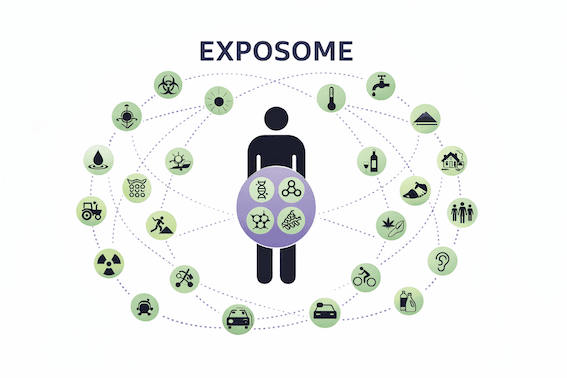
For years, health science focused heavily on genetics — the DNA you inherit and how it shapes your risk for disease. But genetics tells only part of the story (as we know!). A growing field of research now highlights another major contributor to health and aging: the human exposome — the sum total of all environmental exposures you experience throughout life.
Understanding the exposome is reshaping how scientists think about chronic disease, prevention, and longevity. Rather than asking only “What genes do you have?”, researchers are increasingly asking “What has your body been exposed to over time — and how has it responded?”
What Is the Human Exposome?
The term exposome was introduced in 2005 by molecular epidemiologist Christopher Wild to describe the totality of exposures an individual experiences from conception onward.
These exposures include far more than pollution or toxins. The exposome encompasses:
- Diet and nutrition
- Physical activity and sleep patterns
- Social relationships and chronic stress
- Air quality, chemicals, and pollutants
- Medications, infections, and lifestyle habits
- Internal biological processes such as metabolism and inflammation
In other words, the exposome reflects the interaction between your external environment and your internal biology — continuously shaping health across your lifespan.
The three main layers of the exposome
Researchers often describe the exposome as three interconnected layers:
1. External exposures
These are influences that come from outside the body, including:
- Air pollution
- Climate and built environment
- Noise levels
- Socioeconomic conditions
- Chemicals or contaminants
2. Internal exposures
These refer to biological processes triggered by external factors, such as:
- Inflammation
- Hormonal signaling
- Oxidative stress
- Gut microbiome activity
3. Behavioral & lifestyle factors
Daily habits — sleep, stress management, diet choices, movement, substance use — form a major, modifiable part of the exposome.
Together, these create a dynamic “exposure signature” that changes over time.
Why the exposome matters for health and longevity
Twin and population studies suggest that environmental and lifestyle factors often explain more variation in disease risk than genetics alone. The exposome framework helps researchers understand how multiple exposures combine rather than examining one factor in isolation.
This matters because most chronic diseases — including cardiovascular disease, metabolic dysfunction, neurodegenerative disease, and certain cancers — emerge from cumulative influences rather than a single trigger.
Key ways the exposome affects health:
- Shapes inflammation and immune resilience
- Influences metabolic health and mitochondrial function
- Impacts brain structure and cognition through environmental exposures
- Alters epigenetic markers that influence biological aging
Recent large-scale research links exposome patterns with differences in healthy vs. accelerated aging across populations, suggesting that environment and lifestyle can meaningfully affect how fast we age biologically.
How scientists measure the exposome
Measuring every exposure across an entire lifetime sounds impossible — but advances in technology are bringing researchers closer.
Scientists now use tools such as:
- Blood and urine biomarker analysis (sometimes called the “blood exposome”)
- Wearable sensors for air quality and activity
- Satellite and geospatial environmental data
- Multi-omics techniques (genomics, metabolomics, epigenomics)
Large databases like the International Agency for Research on Cancer’s Exposome-Explorer catalog hundreds of measurable exposure biomarkers to help researchers track environmental influences more precisely.
The exposome and personalized medicine
The exposome is often described as the environmental counterpart to genomics. Instead of focusing solely on inherited risk, it allows clinicians to ask:
- Which exposures are driving disease processes right now?
- Which lifestyle factors are protective?
- How can interventions be personalized to reduce cumulative risk?
This approach aligns closely with precision medicine and longevity medicine — fields that emphasize prevention, early detection, and tailored interventions.
Why this concept is especially relevant today
Modern life introduces an unprecedented mix of exposures:
- Constant digital stress
- Artificial light and sleep disruption
- Processed foods
- Environmental chemicals
- Sedentary lifestyles
The exposome framework helps explain why health outcomes vary widely even among people with similar genetics. It also shifts the narrative from inevitability to modifiability — many components of the exposome can be improved through intentional lifestyle changes.
Practical ways to improve your personal exposome
While scientists continue mapping the exposome in detail, several evidence-informed strategies can positively influence your exposure profile:
- Prioritize whole, minimally processed foods
- Reduce chronic stress through recovery practices (breathwork, meditation, time in nature)
- Support healthy sleep and circadian rhythms
- Improve indoor air quality and reduce unnecessary chemical exposures
- Maintain regular movement and social connection
Small daily choices accumulate over years, shaping biological resilience.
The bigger picture: From genes to life experience
The human exposome reframes health as a lifelong interaction between biology and environment. Your genes may set the baseline, but your exposures — what you eat, breathe, feel, and experience — help determine how that biology unfolds.
For longevity-focused thinking, this is a powerful shift: healthspan is not defined only by what you inherit, but also by what surrounds you and how you respond to it.