Movement
2 Must-Try Weighted-Vest Workouts
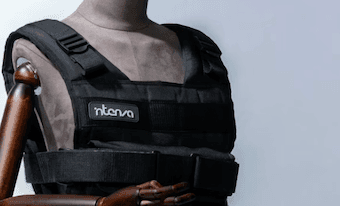
Over the past year, I’ve observed a noticeable shift in how many people are approaching movement: Individuals are clearly looking for ways to get more out of the activities they’re already doing. If you’ve seen “hot girl walks” or the 12-3-30 treadmill workout trending on TikTok, you know what I’m talking about — they often feature individuals wearing weighted vests, one of the most effective and often underrated ways of making your workout work just a little bit harder for you.
Weighted vests have rapidly moved from niche gear to a mainstream training tool for everyone, including strength fanatics, those focused on longevity, and everyone in between — and for good reasons.
- Longevity and bone-density are in the spotlight.
- Strength is being rebranded as antiaging — because it is.
- Time-efficient workouts are a must.
- Tactical, performance-inspired gear is trending.
- Influencers are normalizing resistance in daily movement.
These vests are being donned by exercisers doing all sorts of activities in all sorts of places: on outdoor walks, on the treadmill, on the stair stepper, in a fitness class, or during bodyweight training, to name a few. When something shows up in everyday training and the airport security line (yes, many weighted vests are TSA approved), it’s safe to say it’s officially part of the movement culture.
The Benefits of Weighted Vests
These are a few of the reasons weighted vests are earning their place in fitness spaces.
1. Gain more results without changing the workout.
Adding external load increases the intensity of any movement, whether it’s walking, stair climbing, or another form of exercise — or even doing day-to-day errands or household chores. They increase calorie expenditure and build additional strength without changing the time invested or the form of movement itself.
2. Build strength and improve bone health.
We naturally start to lose muscle as early as age 25, while bone density tends to decline starting around age 35; both rates of loss tend to accelerate as we age. For women, the hormonal changes that accompany perimenopause and menopause can further impact the decline in muscle and bone density.
A weighted vest applies just enough added stress to bones and muscles to help stimulate growth without the use of other types of weights or machines. It’s an approachable form of strength training.
3. Promote better body and core stability.
When you add external load to your frame, such as a weighted vest, your body responds by stabilizing through the core, upper back, and hips to maintain postural equilibrium and spinal integrity. Over time, their use can lead to improvements in posture, gait, and overall alignment.
4. Experience a cardiovascular boost without high intensity or impact.
Even during low-speed movement, the heart and lungs work harder when carrying an external load. Wearing a weighted vest while walking, hiking, or doing low-impact cardio can also add intensity without adding joint stress.
(Learn more: “The Benefits of Adding a Weighted Vest to Your Fitness Routine.”)
The Weighted-Vest Workouts
There’s no learning curve required for exercising with a weighted vest — just throw it on and start moving. It’s one of the simplest upgrades I can recommend for anyone who wants better results from the workouts they already enjoy.
It’s also an ideal training tool for those who may be intimidated by heavy lifting but want to increase their strength and support their metabolism and longevity.
If you’re looking for ways to add a weighted vest into your routine, give the following workouts a try. They simple to perform but powerful for building strength and endurance.
A 30-Minute Weighted-Vest Treadmill Workout
Warm-up: 8 minutes, 6% →8% →10% → 4%, 3.0–3.5 mph. Spend 1 minute at each incline. Repeat twice.
Then do 2 minutes at 5–6% / 8%2.0–2.5 mph / 3.5 mph. At the first incine and speed, spend 30 seconds side stepping on your right side, then 30 seconds side stepping on your left side. Walk for 1 minute at the second incline and speed.
Then switch to 3 minutes at 10% / flat3.5 mph / 4.5–5.0 mph. Spend 1 minute walking at the first incline and speed. Jog for 30 seconds at the second incline and speed. Repeat twice.
Then do 3 minutes12–15% / 4%3.2–3.5 mph / 2.8–3.0 mph. Spend 2 minutes climbing at the first incline and speed. Walk for 1 minute at the second incline and speed.
Then do 7 minutes6% → 10% → 0%2.5 mph / 3.5 mph / Jogging pace. At the first incline and speed, spend 1 minute side stepping on your right, then 1 minute side stepping on your left. Walk for 1 minute at the second incline and speed. Jog for 30 seconds at the third incline and speed. Repeat twice.
Then do 3 minutes8% → 10% → 12%3.2–3.5 mph. Spend 1 minute at each incline.
Finish with 1 minute 0–2%, 2.8–3.0 mph.
Cool down.
A 30-Minute Weighted-Vest Bodyweight Workout
Warm-Up (3 Minutes, Vest Optional)
Brisk walk or march for 1 minute. Get the body warm: Do arm circles forward and backward, plus torso twists for 1 minute. Then Loosen shoulders and spine, moving intuitively. Squat hold with alternating internal hip rotation for 30 seconds. Next, mobilize the hips by rotating one knee inward then back to squat position; repeat with the other knee. Continue alternating knees Continue with bodyweight squats for 30 seconds. Perform slow and controlled.
Circuit 1 (9 Minutes) — Repeat Three Times
Move 1: Walking or forward lunges, 45 seconds/15 seconds rest. Perform alternating legs.
Move 2: Pushups (incline or floor), 45 seconds/15 seconds restIf needed, you can also drop to your knees to perform.
Move 3: Step-ups or box squats, 45 seconds/15 seconds rest. Use a chair or bench if you don’t have access to a box.
Circuit 2 (9 Minutes) — Repeat Three Times
Move 1: bodyweight squats for 45 seconds then rest for 15 seconds. Focus on keeping your chest up and reaching full range (full depth).
Move 2: Plank hold for 45 seconds/15 seconds rest. Perform either on your hands or your forearms.
Move 3: Alternating reverse lunges for 45 seconds/15 seconds rest. Focus on descending with control.
Finisher (9 Minutes) — Repeat Three Times
Move 1: Bear crawl or mountain climbers for 45 seconds/15 seconds rest.
Move 2: Stand and march or high knees for 45 seconds/15 seconds rest. Stand tall throughout the movement.
Move 3: Alternating lateral lunges for 45 seconds/15 seconds rest. Focus on keeping a tall chest.
Cool-Down (1.5 Minutes, Remove Weighted Vest)
Move 1: Standing spinal rotations for 30 seconds. Pull your belly button to your spine and twist intuitively.
Move 2: Cat-cow for 30 seconds. Connect your breath to the movement.
Move 3: Downward dog for 30 seconds. Pedal out your legs and move intuitively.
Final Breaths: Hands at heart, sealed lips, breathe in and out of nose. As long as it takes to recenter. Nasal breathing supports mindfulness and brings your heart rate down.
This article was originally written by Carrie Harris, a studio leader at Life Time, for Experience Life.