Nutrition
The Surprisingly Powerful Longevity Benefits of Fiber
My mother and grandmother called it “roughage.” As a kid, I wasn’t too clear on what exactly roughage was but I knew it had a lot to do with vegetables. By the 1970s, the language had evolved, and nutrition researchers were calling it dietary fiber (as was I), and starting to make the case that our increasingly processed-food-forward diets, with their relative lack of fiber, might help explain rising rates of constipation, heart disease, diabetes and colorectal cancer.
Now the thinking has moved on to fermentable fiber, butyrate and the gut microbiome. And while the names have changed, the grandmotherly advice to eat more roughage hasn’t changed nearly as much as our understanding of why.
These days, the science tells us that fiber does far more than just keep digestion humming and bowels moving. Turns out, different types come with some their own mad skills: Some can lower LDL cholesterol, some slow the rise in blood sugar after a meal, and some feed gut microbes that produce butyrate, a compound that nourishes the colon and helps maintain the gut wall barrier. All of which makes fiber a darn good thing to have in your corner. Or, in this case, your belly.
These firing-on-multiple-cylinders upsides are a big part of why fiber has become such an intriguing element in emerging healthy-aging research, and why it may be time to get a bit more serious about upping your fiber game. Here’s what you need to know about fiber’s impressive partnership with longevity:
Fiber’s got things to do and places to go.
In practical terms, fiber has kind of an odd résumé. It’s a carbohydrate, but unlike sugar and starch, much of it passes through the small intestine without being broken down and absorbed. For years, that made fiber seem mostly useful for keeping you regular.
Turns out, that was only part of the story. Much of fiber’s real work begins after it reaches the large intestine, where different types get busy in different ways before making their exit. Some hold water and add bulk to stool. Some form a gel that can slow digestion and help lower cholesterol. Others are fermented by gut bacteria, which turn them into compounds that help nourish the colon, support the intestinal lining and communicate with the immune system and other parts of the body. Fiber has a lot to take care of on its way through.
And all that activity may pay off over the long haul. Higher fiber intake has been linked to a lower risk of dying from any cause, along with lower cardiovascular- and cancer-related mortality. It’s also strongly associated with a lower risk of colorectal cancer, which is one reason getting roughly 25 to 30 grams a day, ideally from food, is the standard recommendation, depending on your age, sex and calorie intake. However, for many of my patients, I might lean a bit closer to 30 to 40 grams daily, particularly if your fiber’s coming from a varied mix of whole plant foods. Keep in mind though, more doesn’t necessarily mean automatically better. The ‘right amount’ is the amount your gut can comfortably handle, built up over time and always accompanied by enough fluid to help everything move in the right direction.
Soluble, insoluble and why you want both on your plate.
Fiber also has a bit of a split personality. It’s not just one thing: there’s soluble fiber and there’s insoluble fiber, and each behaves a little differently.
Soluble fiber dissolves in water. Some types form a gel in the digestive tract, which can slow digestion, blunt the rise in blood sugar after a meal and help lower LDL cholesterol. Oats, barley, beans, lentils, apples, berries and psyllium are good sources.
Insoluble fiber doesn’t dissolve in water. It adds bulk and helps move food and waste through the gut, which is why whole grains, vegetables, nuts, seeds and fruit with edible skins are useful for regularity.
Even that split, though, is a little too neat. Some fibers are particularly good at feeding gut microbes; others are better at forming a gel or bulking stool. And many foods contain more than one kind, which is a good argument for variety and a bad argument for overthinking the fiber profile of a blueberry. In other words, there’s no need to track each type separately. Cover your bases by eating a mix of fruits, vegetables, beans, nuts, seeds and whole grains.
Butyrate: a small compound with a seriously big job.
When gut microbes ferment certain fibers, they produce short-chain fatty acids, including butyrate. The cells lining the colon use butyrate for energy, and butyrate also helps keep the junctions between those cells strong while helping to regulate immune activity.
That gut lining matters. Your gut needs to absorb nutrients while keeping bacteria, toxins and other things that belong inside the intestine from crossing into the bloodstream. When that barrier becomes too permeable, aka “leaky gut,” that increased permeability can allow more bacterial products to escape through the barrier, potentially stirring up inflammation and weakened immunity.
And aging can make the equation a little trickier. As we get older, the microbiome and intestinal barrier can change, with chronic low-grade inflammation becoming more common. Granted, fiber doesn’t magically switch inflammation off, but feeding your fiber-loving microbes the stuff they thrive on gives them the raw material to make butyrate and other compounds that help support the integrity of your gut barrier. A healthier barrier means less escaping from the gut to stir up inflammation and undermine immunity. That’s one reason researchers think what happens in the gut may have a lot to do with how well we age elsewhere in the body.
Your gut is aging along with the rest of you.
Constipation becomes more common with age for some pretty ordinary reasons: we may eat less, drink less, move less or take medications that slow things down. And when appetite shrinks, fiber intake can shrink right along with it.
The microbiome changes with age too. In a year-long study of adults ages 65 to 79, a Mediterranean-style diet rich in plant foods shifted the gut microbiome in ways linked with less frailty and inflammation and better cognitive function. Fiber can’t take all the credit, but it’s fair to say that an older gut still responds to what you feed it. However, If your appetite has shrunk, don’t load up on so much bulky fiber that you crowd protein and other nutrient-rich foods off your plate. A healthy gut matters, but so does holding onto muscle.
Ramp up fiber slowly.
More fiber isn’t always better, especially if you pile it on too fast. If your breakfast norm has been coffee and a croissant, jumping straight to a morning bowl of bran, berries, chia and psyllium will likely give your gut a working over. Think gas, bloating, cramping and general digestive grumbling.
Instead, increase your daily fiber dose gradually, spreading it across your meals and keep fluids up too. For most healthy women, about 9 cups of fluid a day is a reasonable ballpark, with more needed in hot weather or with exercise. Some fibers soak up water, so too much fiber with too little fluid can actually make constipation worse, while a sudden jump in fermentable fiber can bring gas, cramping and bloating.
And if fiber consistently leaves you painfully bloated or uncomfortable, don’t assume the answer is more. IBS, SIBO and the less common fungal overgrowth SIFO can complicate things. Ordinary bloating doesn’t mean you have Candida, but persistent symptoms are worth sorting out before aggressively piling on fermentable fiber.
The benefits travel beyond the gut.
Soluble fiber can bind some of the bile acids your body uses to digest fat, carrying them out of the body instead of allowing them to be recycled. To replace them, the liver pulls cholesterol from the blood and uses it to make new bile acids. Over time, that can help lower LDL cholesterol, which is one reason foods such as oats and barley, as well as psyllium, can be useful for heart health.
Fiber can also slow the absorption of carbohydrates, helping blunt the rise in blood sugar after a meal.
High-fiber foods also tend to be filling. Beans, vegetables, fruit and intact whole grains take up room, take time to chew and generally digest more slowly than highly refined foods. That can help with appetite and weight management without requiring you to spend the day thinking about calories.
And yes, the brain’s likely listening too.
The gut-brain connection is one of the more interesting parts of the fiber story, though the research is still in its early stages. So far, we know that short-chain fatty acids made in the gut can enter the circulation. Researchers are studying their potential effects on inflammation, the blood-brain barrier and immune cells in the brain. Safe to say, fiber’s not yet an Alzheimer’s therapy, but the early evidence is promising.
A case in point: most recently, a 2026 Japanese study of more than 41,000 adults found that people with higher fiber intake had a lower risk of disabling dementia during follow-up. Because it was observational, it’s not proof that fiber prevented dementia, but it is food for thought (quite literally) and a good reason to think of the gut and brain as connected neighborhoods.
Think food and pass on shortcuts.
So, what does roughly 25 to 30 grams a day actually look like on a plate? Happily, you don’t need a calculator, a food scale or a degree in nutrition to get there. Just take it slow, increasing fiber over time and try to get most of it from actual food.
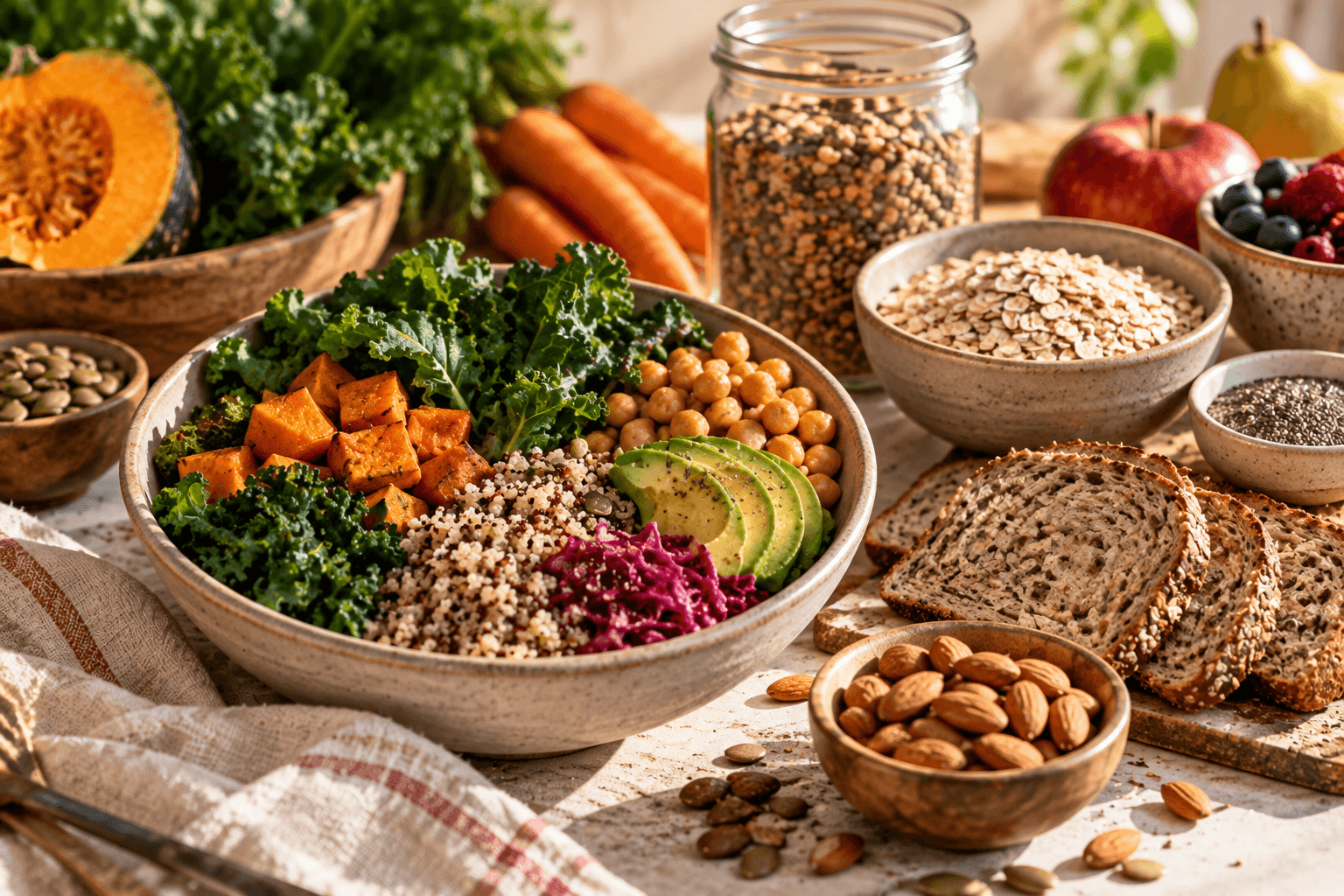
Lean into beans, lentils, vegetables, fruit, nuts, seeds, oats, barley and other whole grains to get a solid mix of fibers along with vitamins, minerals, healthy fats, protein and other plant compounds. Pass on highly processed cookies and snack bars. For everyday eating, let most of your fiber come from plants that still look like plants.
Get your grams without making it full-time job.
Ultimately, getting enough fiber is one of the easier ways to do your body a lot of favors. Add in the longevity connection, and chances are you’re making a pretty good investment in your long-term health without having to work all that hard at it. You’ll help keep your aging gut moving, support the integrity of the gut barrier, feed the microbes that make butyrate, help with cholesterol and blood sugar, and you may even support brain health as you get older. What’s not to love?
Better yet, the practical part is much simpler than the biology. The easiest rule is also the least glamorous: eat a whole plant food at every meal and vary the plants over the week. You’re more likely to hit your target without thinking about fiber all day. Here’s a quick guide to getting your daily fill:
At breakfast: oatmeal with berries and a tablespoon of chia or ground flax can put a good dent in the day’s total. If you’re an eggs-for-breakfast person, add berries, an apple or whole-grain toast instead.
At lunch: beans, chickpeas or lentils are easy wins. Half a cup of cooked lentils has roughly 7 to 8 grams of fiber. Add them to soup or salad or have hummus with vegetables and a piece of fruit.
At dinner: keep your protein and add one or two plant foods: broccoli, Brussels sprouts, peas, beans, barley, quinoa or a baked potato with the skin. Fruit, nuts or seeds can fill in the gaps.
In a pinch: If you fall short on occasion, an occasional dose of plain psyllium husk can help. It’s one of the better-studied supplements and can help with constipation and modestly lower LDL cholesterol, though it doesn’t replace the mix of fibers in whole foods. Start with the smallest dose, increase slowly and take it with at least eight ounces of liquid. If you take prescription drugs, ask your pharmacist how to space them.
For something we don’t actually digest, fiber gets an impressive amount of work done – so dig in!