Healthy Aging
The Hidden Heart Risk Your Cholesterol Test May Be Missing
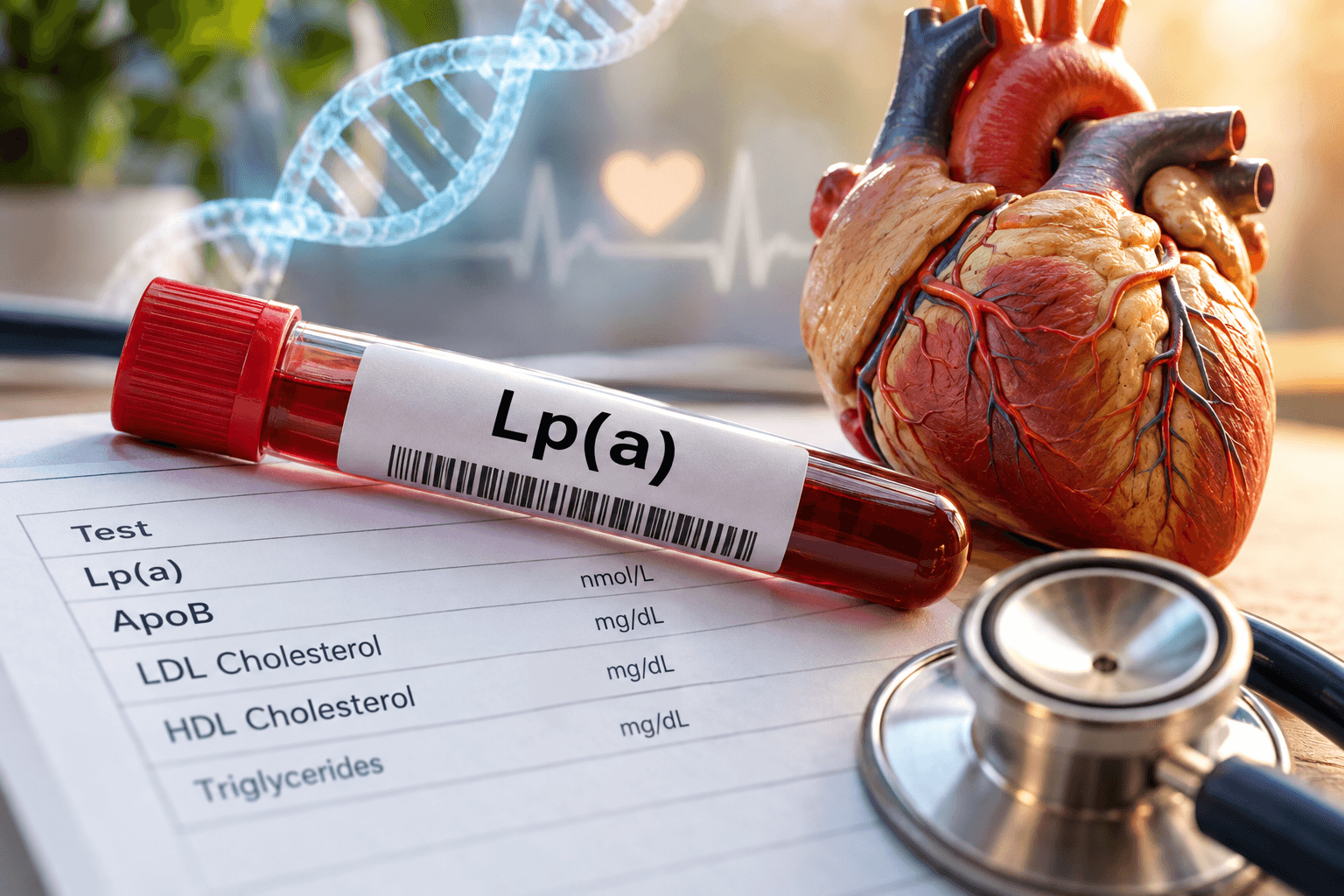
Just about every patient I see knows their LDL cholesterol number, and more and more are getting to know the more important number, ApoB too. LDL measures the cholesterol carried in LDL particles; ApoB reflects the number of potentially plaque-forming particles, a better way to uncover risk LDL alone can miss. But here’s the dirty little secret of cardiology. About half the people who suffer heart attacks don’t have elevated LDL levels, according to national standards for healthy adults, and they often don’t have especially high levels of other accepted cardiac risk factors.
These folks likely have a heart attack risk that is genetically predetermined. The most powerful predictor of this heritable risk is a special type of LDL particle called lipoprotein a or Lp(a), pronounced “L P little a.” A standard lab test can readily measure it but, until the past few years, most doctors, and insurers, routinely ignored it. The short-sighted thinking was: unlike standard-issue LDL, we can’t meaningfully lower Lp(a) with either lifestyle upgrades (diet especially) or with pharma drugs. So why bother testing?
At last though, there’s been a shift and finally, common sense is breaking through. Fact is, you really do need to know your Lp(a) to evaluate your overall cardiac risk. A high number, which roughly 20% of the population has, means you must be that much more rigorous about addressing the numerous risk factors that you can push down – high LDL, blood pressure, blood sugar, systemic inflammation. Where to start? What do you need to know? Here’s my topline on a particle and a blood test that just might save your life.
What is Lp(a) exactly?
Apologies, but I’m going to back into this story by introducing another crucial cardiac particle, apolipoprotein B. ApoB is the carrier, built from lipid and protein, that transports LDL around the bloodstream and that can take it into the lining of the coronary arteries, with often dangerous results. Get your ApoB tested. It’s a better marker of heart disease risk than total LDL – the more carriers floating around your bloodstream, the more potential for trouble. And Lp(a) is a specific variant of these Lp (lipid-protein) particles that’s particularly nasty. It’s covered in a “camouflage” protein that makes it difficult for the liver to clear it from the bloodstream. And once an Lp(a) particle makes itself at home in the lining of a coronary artery, it promotes inflammation and clot formation, hastening the growth of plaque. Not only does it drive the progression of heart disease (by some estimates it’s roughly 6-7 times more “atherogenic” than regular LDL), but it also contributes to the thickening of the aortic valve which restricts blood flow to the rest of the body.
All in the family.
Although physicians going back to the ancients recognized that certain diseases “ran in families,” it wasn’t until the middle of the last century that Western medicine established that a patient who had family members who had suffered from heart disease were at greater risk for it themselves, independent of how healthy or unhealthy their particular lifestyle was. And it wasn’t until the 1980s that we had blood tests sensitive enough to meaningfully measure Lp(a) particles, which as best we know now, are responsible for much of that inherited risk. And it’s only been in the last 5–10 years that the major heart organizations woke up and recommended that everyone get tested – once in a lifetime usually does the trick. The health insurance industry has yet to come onboard, although most seniors have some sort of cardiac health issue that can be flagged, in which case Medicare will cover. If you are paying out-of-pocket, that’s a $100 or less investment in your heart health you can’t afford not to make.
Making sense of the numbers.
The numbers can get a bit tricky since Lp(a) is measured two different ways. But here’s the need-to-know takeaway. An Lp(a) reported in nmol/L that is below 75, or in mg/dL, below 30, is considered desirable. If those are your numbers, you can thank your relatives. An intermediate level that suggests some additional heart risk is 75 to below 125 nmol/L or 30 to below 50 mg/dL. And a high level, in other words, an unambiguous higher risk, is 125 nmol/L or above, or 50 mg/dL or above. If you fall within the intermediate level, and most definitely in the high level, it’s time to get to work. (Research has established that people with very high levels, above 250 nmol/L, about 10% of the world’s population, have double the average risk of heart attack and stroke.)
Fighting back.
Likely nothing you do will change your Lp(a) number, but there’s plenty you can do to lower your overall heart disease risk, beginning with the lifestyle fundamentals of diet, movement, sleep and stress management. You’ve probably heard me say this before, but it bears repeating. Diet is key. Lose the sugar and the refined carbs, embrace the veggies and high-fiber foods in general. When it comes to movement, a regular exercise program is great but just as, or more, important is staying as physically active as possible throughout the course of the day. Seven to eight hours of sound sleep is non-negotiable, as is keeping a lid on stress, whether you have a formal de-stressing program like meditation or yoga, or you just make sure to take time out every day to catch your breath and tune out the world.
Where the drug story stands right now.
While you can’t do much about your Lp(a) number, the pharma industry has been hard at work developing drugs that will do it for you. The whole Lp(a) story took an unexpected turn just recently when the results were published of seven-year-long randomized clinical trial of an experimental Lp(a) drug. The experiment failed. The drug did lower Lp(a) in the study group of patients with heart disease, but it did not reduce the incidence of “adverse cardiac events” – heart attacks, strokes and the like. Other drugs are in the clinical trials pipeline so it’s possible the final verdict hasn’t been delivered. This result doesn’t prove that Lp(a) is harmless; it reminds us that lowering a blood marker and preventing heart attacks aren’t necessarily the same thing.
There’s also an interesting hormonal connection. Anecdotally, I’ve heard reports of higher doses of oral estradiol bringing Lp(a) down (in men and women), and clinical studies have shown that oral estradiol can lower it in postmenopausal women. But oral estrogen carries clotting risks, and lowering Lp(a) this way hasn’t been shown to prevent heart attacks.
Know your numbers, and what they mean.
My regular readers know that whenever possible, I favor upgrading lifestyle over reflexively resorting to the prescription pad. But drugs have their place in preventing and treating heart disease, especially when Lp(a) is elevated. A patient with an LDL cholesterol level of 100 to 120 mg/dL might once have been reassured and told to improve her diet and exercise. If she also has high Lp(a), that advice alone may not be enough. And this is where ApoB deserves more attention than LDL cholesterol alone. LDL tells us how much cholesterol is carried in LDL particles; ApoB reflects the number of potentially plaque-forming particles circulating in the blood. When those measurements tell different stories, cardiovascular risk generally tracks more closely with ApoB. A reassuring LDL number shouldn’t end the conversation if ApoB remains elevated.
How low should those numbers go? Depending on your overall risk, your physician may recommend an ApoB below 70 mg/dL for high risk, or below 60 mg/dL for very high risk, alongside an LDL below 70 or 55 mg/dL, respectively. Elevated Lp(a) strengthens the case for tighter control, but your target should also reflect your medical history and other risk factors. Cholesterol-lowering medications can help reduce this particle burden.
If the treatment decision remains uncertain, a coronary calcium scan or coronary CT angiogram with Cleerly analysis can help guide how aggressively to treat. A calcium scan measures calcified plaque, while a coronary CT angiogram uses contrast dye to reveal both calcified and noncalcified (“soft”) plaque, which Cleerly’s software then quantifies and characterizes. A calcium score of zero is reassuring, but it doesn’t rule out noncalcified plaque or erase the long-term risk associated with elevated Lp(a).