Healthy Aging
The Hidden Fluid Network Inside Your Body—and What It May Mean for Aging
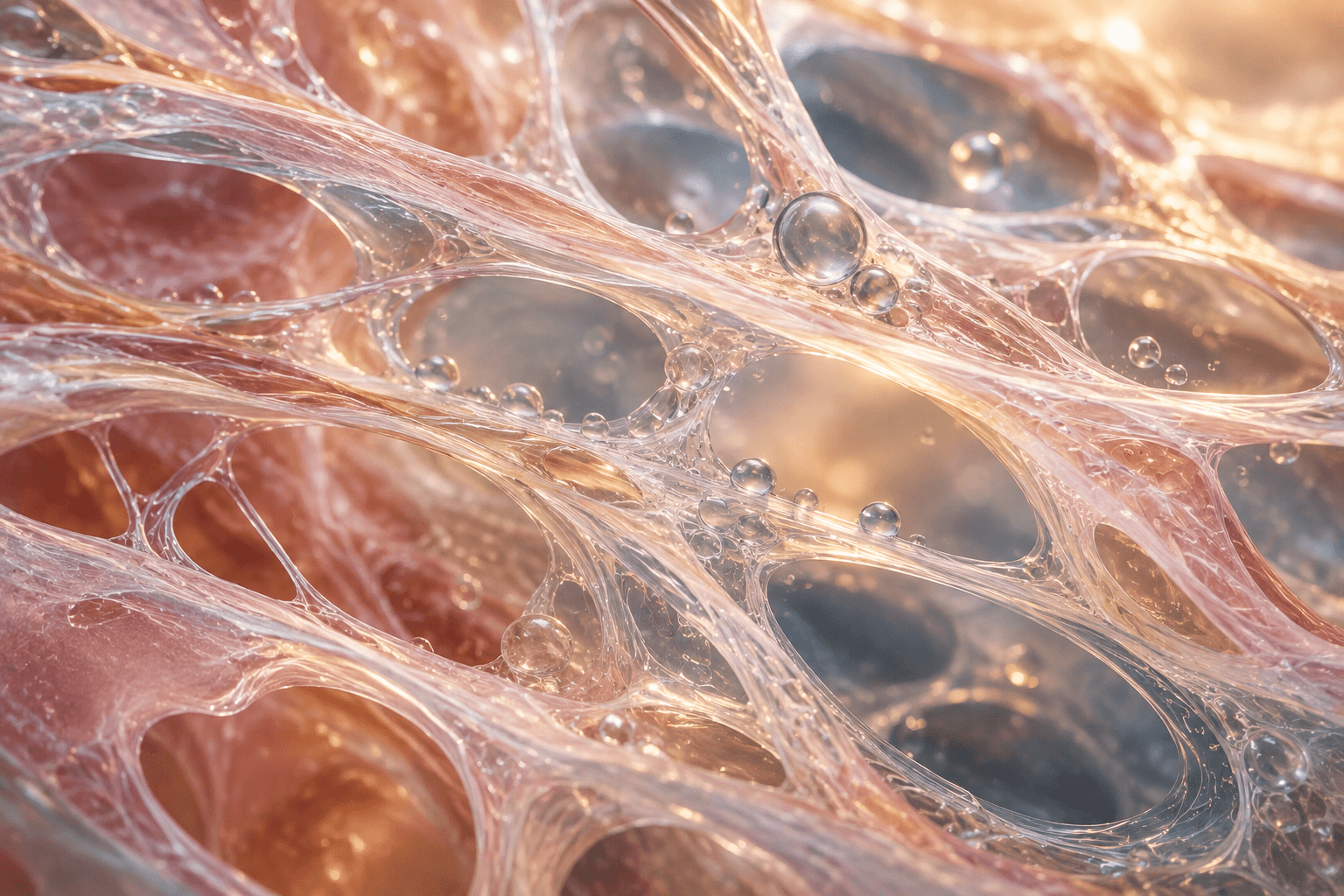
Every so often, modern medicine catches up with something we integrative practitioners have been observing for a long time. It looks like the interstitium, a word few doctors have ever uttered until recently, may be having that moment.
Why now? Well, much of the recent buzz was triggered by a May 2026 New York Times Magazine article that brought the interstitium into wider view: a body-wide network of fluid-filled spaces woven through our connective tissue. The article explored its possible role as a sort of third fluid-transport system, distinct from the cardiovascular and lymphatic systems. It also raised an interesting possibility: that these pathways may overlap with the meridians we know from Chinese medicine.
For me, the concepts underlying the interstitium aren’t exactly new news. Having practiced acupuncture for 40 years, I’ve witnessed almost daily how work in one part of the body can influence another. I’ve seen a needle placed in one area produce effects somewhere quite distant from where it was inserted. I’ve also seen how fascia, the connective tissue that wraps around and connects our muscles and organs, does far more than simply hold everything in place. It acts more like a living communication network.
What is new is that, at last, science is beginning to recognize and describe an anatomical system that looks remarkably compatible with the meridians Chinese medicine have talked about for centuries. In traditional Chinese medicine, meridians are pathways that connect different parts of the body. They are the routes along which Qi, or vital energy, is believed to flow. Acupuncture points sit along these pathways, which is why stimulating a point in the leg, for example, may affect something happening farther away in the body.
So, what, exactly, is this fascinating third system, and why does it matter? Here’s what you need to know.
The “space” between tissues turns out to be very busy.
For much of modern anatomy, the tissue between organs, muscles, blood vessels and nerves was treated mostly as background support. A reasonable enough approach but newer research now paints quite a different picture, of a connected, active environment that helps move fluid and signals through the body.
Neither an organ nor a vessel, a 2026 review describes the interstitium as a body-wide network of fluid-filled spaces, from the tiny gaps between cells to larger spaces within fascia. These spaces are supported by collagen and rich in hyaluronic acid, which holds onto water and helps keep the tissue hydrated and fluid-filled.” They’ve been found in fascia, skin, around blood vessels and nerves, and within and around organs.
One reason the scientific community missed this architecture for as long as it did was that the usual way of preparing tissue for microscope slides can collapse these fluid-filled spaces. In the 2018 study that helped bring the interstitium to wider attention, researchers found that routine tissue processing drained away the fluid that normally keeps collagen bundles separated in the body, causing those spaces to collapse.
Using imaging that allowed them to look at living tissue, researchers saw a lattice of fluid-filled spaces in the bile duct and later found similar structures in the digestive tract, bladder, skin, around blood vessels and bronchi, and in fascia. The crazy thing is, this architecture had been there all along. We just weren’t looking at it in a way that allowed us to actually see it!
Think of the interstitium as a body-wide fluid network.
Some researchers have described the interstitium as a kind of third circulatory system, alongside the cardiovascular and lymphatic systems. Blood moves through blood vessels. Lymph moves through lymphatic vessels. Interstitial fluid moves through spaces around cells and within connective tissue, and much of it eventually drains into the lymphatic system. That fluid carries proteins, nutrients, waste products and chemical signals, making it less like a basic plumbing structure and more like a wet, three-dimensional web. Collagen helps support these fluid-filled spaces, while hyaluronic acid holds onto water within the tissue. As we move, the surrounding tissues stretch, compress and shift, which can also influence how that fluid moves.
Acupuncture enters the conversation – and makes a point.
For anyone who practices acupuncture, this third system idea feels familiar, not to mention vindicating. For years, researchers have been trying to figure out whether meridians may correspond, at least in part, to connective-tissue pathways. Then, a 2002 study found that more than 80 percent of the acupuncture points mapped in sections of the human arm lined up with connective-tissue planes between or within muscles.
What’s especially interesting is what the tissue actually does once the needle is in. Practitioners know the feeling of a needle being “grabbed.” Research has shown that connective tissue actually winds around a rotating needle, creating tension in the surrounding tissue and prompting nearby fibroblasts, the cells that build and maintain connective tissue, to change shape.
That response does not necessarily stay at the needle site. Ultrasound studies have measured tissue movement several centimeters away, especially along connective-tissue planes. And researchers using MRI and fluorescent tracers have observed interstitial fluid moving away from acupuncture points through pathways that did not simply follow blood or lymphatic vessels.
These pathways don’t line up perfectly with traditional meridian maps, but there is enough overlap to make the connection hard to ignore. We still have plenty to learn about exactly how the two relate, but the research is moving in a very interesting direction.
For centuries, acupuncture’s been based on the idea that the body is connected through pathways, so working in one place can affect another. Now modern imaging is beginning to reveal physical pathways through connective tissue and interstitial fluid that may help explain how those distant effects happen.
Fascia is in the chat too.
The interstitium story is also closely tied to fascia, the connective tissue that wraps around and links our muscles and organs. Once treated mostly as structural support, fascia is now understood as a body-wide network with nerves, blood vessels and fluid-rich layers that help tissues move and slide. Those fluid-rich layers contain plenty of hyaluronic acid, which helps tissues stay slippery and mobile, while collagen gives them strength.
This helps explain why things like acupuncture, massage and stretching can have effects beyond the exact spot being worked on. When fascia is stretched, pressed or needled, the tissue responds. You can often feel this in a very practical way. After massage, stretching or acupuncture, tissue may feel looser, movement may come more easily, and areas that felt tight or restricted can soften.
The interstitium matters far more than just as an acupuncture helper.
The interstitium may also hold some serious sway over disease development as well. Because its fluid-filled spaces connect with the lymphatic system, researchers are looking at whether they may give cancer cells another route toward lymph nodes.
These spaces are also involved in inflammation and immune activity. And when the connective tissue around them becomes abnormally thick or stiff, fibrosis can develop in organs including the lungs, liver, kidneys, heart and skin
Researchers have also found that some interstitial spaces continue across tissue layers and even organ boundaries. That raises another interesting possibility: they may help carry signals and substances from one part of the body to another. Which is a useful reminder that, while medicine tends to divide the body into separate specialties, the body itself is very much a whole.
Why this interests me for longevity
A lot of longevity medicine focuses on things we can measure: cholesterol, blood pressure, glucose, muscle mass and bone density. But aging also changes the tissue that holds and connects everything together. Collagen stiffens, elastin declines, and tissues become less flexible. Fibrosis and other changes in connective tissue also become more common with age.
That’s part of what makes the interstitium so interesting in the context of aging. Understanding this fluid-filled network may give us new ways to keep tissues healthy, mobile and responsive, slowing some of the changes we associate with aging.
What does this mean for patients in practice?
It doesn’t mean we suddenly need to “treat the interstitium,” buy a special device or take a supplement promising to optimize it. The more useful takeaway is much simpler: movement and stretching push and pull on the fascia and the fluid-rich tissue within it, helping the layers move freely and supporting normal fluid exchange through the tissue. Massage and other hands-on therapies do the same. Acupuncture creates a more focused mechanical effect: rotating a needle can wind connective tissue around it and trigger changes in nearby cells.
So, keep moving. Walk, stretch, reach, twist and strength train. Spend less time sitting in one position. And if acupuncture, massage or other forms of bodywork help you move and feel better, we may now be getting a clearer picture of the biology behind those effects.
Science is giving us a new language, at last!
Granted, there’s still a good bit we don’t yet know about the interstitium, but that doesn’t mean the idea of a body-wide network is entirely new. Practitioners of acupuncture and other traditional therapies have been working with a version of that for centuries.
What’s new is that modern anatomy is beginning to see and measure it in its own language. The net yield is that may learn a lot more about pain, healing, inflammation and aging, with the potential to change how we understand and treat the body for generations to come.
Sometimes science just needs a little time to catch up.