Nutrition
The Easiest Health Hack in Your Kitchen? 7 Little Seeds With Big Dividends
For some of us, the idea of overhauling your life to enhance your health and wellness seems daunting, even overwhelming. My advice: break it down into manageable steps! Every step you take today can move you closer to where you want to go, assuming you’re making the right moves, and enough of them, over the course of a lifetime.
What you eat, how well you eat, is a big part of the road map. And here’s what I’ve learned after doing this for a long time: the most reliable nutritional “wins” rarely look dramatic. More often, they’re as simple as a spoonful of something small, tossed into a meal you were going to eat anyway.
Seeds are a perfect example. For such tiny foods, they pack an extraordinary amount of nutritional firepower into a small package: fiber, unsaturated fats, plant protein, minerals and a range of bioactive compounds that can help support healthy aging.
Of course, eating for longevity is less about any single ingredient and more about your overall pattern of eating. A spoonful of flax here or a scoop of hemp hearts there isn’t going to undo a bad diet, but it will enhance the power of a good one. Harvard researchers have come to the same conclusion, finding that while there is no single diet for longevity, dietary patterns rich in minimally processed plant foods, including nuts, seeds and legumes, are consistently associated with healthier aging and a lower risk of premature death.
My recommendation? Skip the trendy TikTok hacks and health-influencer hype and, instead, amp up your seed game. It’s an easy, low-effort way to nudge your everyday eating in a more longevity-supporting direction.
Here are seven seeds that are always in our kitchen, and certainly worth adding to yours.
Flaxseed: the little seed with big heart credentials.
If I had to pick a favorite seed, and one with the deepest research behind it, it would be flax. It's one of the richest food sources of alpha-linolenic acid, or ALA, a plant-based omega-3. A meta-analysis pooling more than 250,000 people found that higher ALA intake was tied to meaningfully lower cardiovascular risk, and what’s more, each extra gram of ALA people ate per day was linked to roughly a 10% lower risk of dying from coronary heart disease. We like those odds.
And the case for flaxseed gets even more interesting when you look at what the seed actually does in the body. A meta-analysis of 62 randomized trials found flaxseed supplementation significantly reduced total cholesterol, triglycerides, and LDL cholesterol. A more recent 2024 meta-analysis of studies on people with cardiovascular risk factors found flaxseed lowered both systolic and diastolic blood pressure. So, fair to say, flax lands firmly in the “please eat” category.
Then there are lignans, compounds concentrated in flax that your gut bacteria convert into estrogen-like metabolites. Genuinely interesting stuff, and researchers are still digging into it. Keep in mind, though, that claims that flax will “balance your hormones” or prevent hormone-related cancers are running well ahead of what the human evidence has yet shown. So yes, promising, but let’s stand by for more definitive research before drawing those kinds of conclusions.
One practical tip: whole flaxseeds can pass right through you without breaking down, so buy them pre-ground, or grind them yourself, and store the ground flax in the fridge so those fragile fats don't go rancid on you.
Seeds of change: To up your flax game, whisk a tablespoon of ground flax into your scrambled eggs right before they hit the pan. It disappears into the eggs, adds a faint nuttiness, and ramps up breakfast into an omega-3 delivery system without noticeably changing the dish.
Chia: the fiber heavyweight wrapped in a tiny package.
Chia has been a star for a while now, and it deserves many of its accolades. But its real superpower is quite basic: fiber. Mix chia with liquid and it quickly forms a gel, making it incredibly easy to bulk up a meal with the fiber you’d otherwise have to work harder to get. It’s a no-fault fiber fix – it won’t change the tase of whatever you’re consuming.
When it comes to cardiometabolic health though the results are mixed. But overall, studies still paint a pretty compelling picture of the potential upsides. For example, a 2024 meta-analysis of 14 trials found that chia offered benefits for cholesterol, blood pressure and body weight, particularly at higher doses. The findings aren’t entirely consistent, however. Another 2024 review in overweight adults found no meaningful changes in most lipid markers, but did reveal other favorable effects, including reduced waist circumference, lower systolic blood pressure and lower CRP, a marker of inflammation. So, while chia may not be an across-the-board metabolic fix, it still has plenty to crow about in the overall health-supportive department.
One caution: chia soaks up a ton of liquid, so it’s best to mix it into something moist, like water or yogurt, rather than swallowing it dry, which can pose a swallowing risk, particularly for people who already have difficulty swallowing.
Seeds of change: Got hummus? Stir in a spoonful of chia, give it about ten minutes to thicken, and voilà! You’ve given your snack an instant fiber and plant-based omega-3 upgrade.
Pumpkin Seeds: a mineral gold mine in miniature.
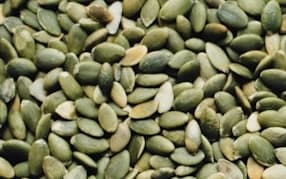
Humble pumpkin seeds (or pepitas) are the ones I reach for when I want a grab-and-go snack that delivers the goods, as in protein, unsaturated fats, and two minerals most of us don't get enough of: magnesium and zinc.
Magnesium is a hard-working nutrient that’s a cofactor in more than 300 enzyme systems that govern muscle and nerve function, blood sugar control, blood pressure regulation, you name it. Zinc is needed for roughly 100 enzymes and plays a big role in immune function. Now, eating pumpkin seeds isn't likely to fix a mineral-depleted immune system all by itself, but it's a genuinely useful whole-food source of nutrients your body needs to function well.
Hair beginning to thin a bit? Pumpkin seeds may be able to help (a little). There’s some intriguing, if preliminary, research on hair growth: one small trial found that pumpkin seed oil improved hair growth in men with androgenetic alopecia, though that’s a long way from proving that eating pumpkin seeds will regrow your hair.
Seeds of change: Crush up toasted pumpkin seeds and press them onto a piece of salmon or a pork chop before you sear it. You get an actual crust, more flavor than typical breadcrumbs would add, and a mineral boost baked right into dinner without any extra effort. Score!
Sesame: open sesame to better nutrition.
Sesame has been part of human diets for thousands of years, but nutritionally, there’s more going for it than history. Beyond its unsaturated fats, sesame contains distinctive lignans, including sesamin, that researchers have been studying for their potential cardiometabolic effects.
A meta-analysis of 16 randomized trials found that sesame intake significantly decreased total cholesterol, triglycerides, blood pressure, body weight and waist circumference compared with control groups. That’s a pretty comprehensive list of cardiovascular risk factors, though the researchers noted that larger trials are still needed. A separate review in people with hypertension found the evidence promising but limited by the small size of the studies. So, the news is definitely encouraging.
How to get more sesame quickly? The easiest way is to eat plenty of tahini, which is really just sesame ground into a rich, creamy paste.
Seeds of change: After roasting vegetables, whisk tahini into the pan drippings, with a splash of lemon juice and a little water. In seconds, you've got a fuss-free sauce that instantly elevates the veggies flavor and their nutrition.
Hemp Seeds: protein without the production number.
In my opinion, hemp hearts are an excellent seed for people who want more plant protein but don’t want to think too hard about how to get it. Hemp supplies all nine essential amino acids, giving it a strong, complete protein profile. So, it’s a useful contributor to your total protein intake, particularly if you’re eating more plant-forward.
Hemp also has a practical perk: it comes ready to eat, right out of the box (or bag). No soaking, grinding or aggressive chewing required.
There’s also some interesting early research into hemp’s phytochemicals and their potential neuroprotective effects. For now, though, most of that work is still being done in animal studies, so, too soon to say whether hemp seeds can help prevent Alzheimer’s, Parkinson’s or over-all cognitive decline in people. Consider this one still a work in progress.
Seeds of change: Fold hemp hearts into your pancake or waffle batter right before you cook it. You’ll barely notice a texture change but, with just a dollop of hemp hearts, you’ve added complete plant protein to a meal that otherwise can fall nutritionally short.
Sunflower Seeds: eat your ‘E’s’.
Synonymous with sunshine and summertime flowers, sunflower seeds don’t get the attention that chia and flax do. They remain slightly under the radar, even though they’re one of the most concentrated food sources of vitamin E, an antioxidant that helps protect cells from oxidative damage and supports immune function. The NIH specifically calls out sunflower seeds as one of the best food sources of vitamin E, right alongside almonds and certain oils.
Sunflower seeds also bring plenty of healthy unsaturated fats to the table, and Harvard’s Nutrition Source lists sunflower alongside flax, pumpkin and sesame as especially good sources. Go for unsalted or lightly salted when you can, especially if blood pressure is something you’re watching.
Seeds of change: Blend toasted sunflower seeds into pesto instead of pine nuts. It costs a fraction as much, makes a surprisingly creamy sauce, and delivers lots more vitamin E than the traditional version.
Poppy Seeds: more than just a bagel topper.
When you think poppy seeds, you probably picture a light scattering on a muffin or atop a bagel, and not much else. That’s a nutritional oversight because these seeds bring minerals and healthy fats to the table and deserve a little respect!
With poppy seeds you may also think of the urban legend first popularized in a classic Seinfeld episode, that poppy seeds will make you fail a drug test like Elaine did back in the day after indulging in a few too many poppy seed muffins. Though it is partially a legend, there is a grain of truth in this idea. Turns out, harvesting the seeds can cause opioid chemicals from the sap of the poppy plant to contaminate the seeds. A controlled study found detectable levels of morphine and codeine after healthy adults ate measured amounts of raw poppy seeds. The issue is well documented enough that the U.S. Department of Defense warned service members in 2023 to avoid poppy seeds before drug screening. For everyone else, normal culinary use is considered safe. Think of it as a reason to skip the everything bagel before a drug test, not to avoid poppy seeds in everyday cooking.
Seeds of change: Mix poppy seeds into a lemon vinaigrette for shaved fennel or roasted carrots. They add crunch and a faint nuttiness without turning the dish sweet, as they often do in baked goods.
Sow the seeds of success.
OK, so now the question is: how do you get more seeds into your rotation without stressing about it? Here’s one easy idea for your kitchen: Set up a little “seed station” instead of leaning on one seed to do everything. Keep three or four small jars somewhere near where you actually cook. Ground flax, hemp hearts, pumpkin seeds and tahini or sesame seeds make a solid starting lineup. Then start tossing these small, nutrient-dense foods into meals whenever the opportunity presents itself.
Integrating more seeds into your day is a tiny, minimal-effort change, but with a real body of research suggesting the benefits can add up over time. Think of it as a way to sow the seeds for better health for years to come.