Nutrition
My Go-To Green List: Ten Veggies That Do the Heavy Lifting for Your Health
Hippocrates said, or at any rate is supposed to have said, “Let food by thy medicine, and medicine by thy food.” More than two centuries later, that philosophy flies under the banner, “Food as medicine.” However you phrase it, it’s an excellent reminder not to get so caught up in meal timing regimens or the ins and outs of particular diets that we forget the most important thing, the food itself. And no type of food does a better job of keeping us intact and thriving than vegetables, in particular the “non-starchy” veggies: heavy on the water, fiber, and nutrients, and light, very light, on the calories. Vegetables come to us in an astounding number of species, even of species families. But I can’t think of a richer, or more health and longevity-supporting haul of veggies than those of the green persuasion.
Green veggies are packed with vitamins and minerals that we call essential, necessary for the bio-chemical reactions inside our bodies that keep us alive. And they’re also loaded with “phytonutrients,” not essential but valuable, whose benefits nutritional scientists have been steadily unearthing over the past four or so decades. The plants evolved them as protection against the sun’s ultra-violet rays and the oxygen in the atmosphere. When we consume the plants, we integrate these compounds into our own antioxidant defenses. Often these phytonutrients lend the plants a sharp or even bitter taste which deters animals and insects from feasting on them. But over the millennia, we’ve developed a taste for them (our children, not always) such that eating green vegetables is a pleasurable “good for you” habit.
As a lover of all things green (at least in the veggie aisle) I’ve compiled my Terrific Ten list of green veggies – and why you should always make room on your plate for these edible health and longevity elixirs. Bon appetit!
Broccoli, king of the Brassicas.
Broccoli belongs to the Brassica family of veggies, also known as cruciferous for their cross-shaped flowers. All of the Brassicas are nutritional powerhouses, but broccoli can be considered, nutritionally speaking, best in class. Like many of the veggies on the list, it’s a fine source of vitamin C, important for immune function and skin health, and vitamin K, necessary for bone health, as well as the mineral potassium, which aids circulation. And, like the rest of the Green Teamers, it’s full of prebiotic fiber that feed the bacteria in the gut microbiome, important for gut health and function. But what really makes broccoli stand out are the sulfur and nitrogen-based compounds, aka the glucosinolates which turn into sulforaphane in the body, to get specific. Research has linked the consumption of these compounds with reductions in the risk for certain cancers. One large meta-analysis (a study of studies) found that eating the equivalent of ½ cup of broccoli a day was associated with an almost 20% lower rate of colon cancer. These compounds are also considered a key ally in the liver’s 24/7 detoxification process, in particular, helping to neutralize estrogen break-down products which can cause enervating perimenopause and menopause symptoms.
How to do broccoli right? I like a lightly steaming or roasting to preserve the sulfur compounds, though finely chopped in a salad is a nice addition too. Broccoli also shows well in stir fries, or blended into hearty soups.
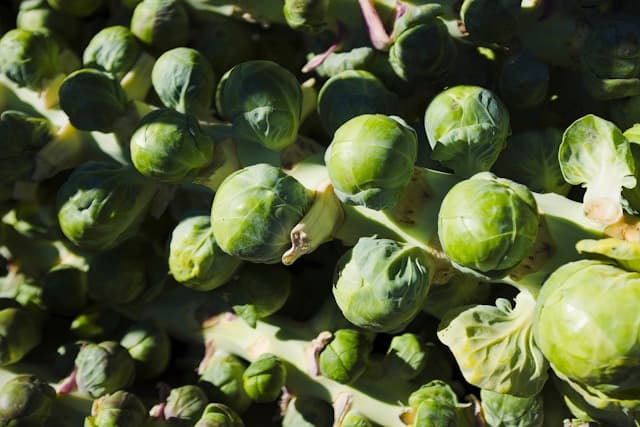
Brussels Sprouts – pungent yet close to perfect.
Here’s another stand-out from the Brassica family, with the same nutritional virtues as broccoli if not in as concentrated form – vitamins C and K, glucosinolates/sulforaphane, plenty of fiber. But a big reason they make the list is that the taste of Brussels sprouts has been rehabilitated. Traditionally boiled until they were a slimy mush, modern cooks have discovered that when they’re roasted in the oven, they have nutty sweetness that all their own.
I like mine roasted until they caramelize just a bit, or sauteed with mushrooms. When summer heat cries out for cool a crunchy salad, shaved brussels spouts with extra virgin olive oil, apple cider vinegar, pumpkin seeds seasoning and chopped apple is an easy, speedy prep option.
Cabbage – lots of nutritional bang for your buck.
Green cabbage (as well as its purple and white siblings) packs the usual beneficial vitamins and minerals, but as a member of the Brassica family, it also packs those distinctive sulfur compounds. But what makes cabbage truly special is its fiber. As with the other greens, it’s prebiotic, which the gut bacteria feed on, enhancing the number and diversity of “good” bacteria, supporting digestion and the gut immune system. And a well-fed microbiome produces more short-chain fatty acids which serve to protect the lining of the gut from leaks that could otherwise trigger inflammation throughout the body. But cabbage fiber rates special mention because it lends itself so well to making fermented foods, think dishes like sauerkraut and the spicier Korean kimchi. These foods are “probiotic” meaning that when you eat them, you’re also consuming the bacteria that come along for the ride. Some research suggests that these “transient” bacteria may improve metabolic health, helping to lower cholesterol and blood sugar levels.
When you roast cabbage, or give it a light sauté, the taste will morph from sharp and sulfurous to sweet and buttery. The trick is avoid overcooking to preserve the texture and tame the powerful sulfur aroma that can scare off the kids (and some adults too)! Don’t feel like cooking? Then try fermenting cabbage with a bit of water salt, and a mason jar, then let nature take its course.
Kale – the trendy veg, from garnish to main event.
Once relegated to mere garnish status, over the past decade or so, kale has become something of a trendy veg and it deserves its spot in the sun. For starters, it belongs to the Brassica family but, because of its leafy structure, it’s usually referred to as a “leafy green.” And typical of the leafy greens, which rival the Brassicas in their “food as medicine” potency, it’s a rich source of iron, calcium and folate (B9), the latter, an important energy molecule that helps keeps genes on track (gene dysregulation is a key driver of harmful aging) and, during early pregnancy, protects against neural tube birth defects. Like its fellow leafy green, spinach, it’s high in nitrates that help relax the blood vessels in the body and protects against high blood pressure and heart disease. Again, like spinach, it’s loaded with carotenoid compounds, for instance lutein and zeaxanthin, which protect against eye diseases, for instance, age-related macular degeneration.
How to boost your intake? Add finely chopped kale to soups and stews, or toss with quinoa, nuts and a light vinaigrette for a healthy lunchtime salad. Top with some roast organic chicken or wild salmon and your off to the nutritional races. Need an afternoon or nighttime snack? Home baked kale chips are winners.
Spinach – if it’s good enough for Popeye...
Nutritionally speaking, spinach is the most muscular of the leafy greens – just ask those early wellness influencers Popeye and Jack Lalanne. Like kale, but even more so, it’s packed with iron, folate, vitamins A, C, K, as well as the nitrate compounds whose blood-vessel relaxing properties become ever more valuable as we grow older and more vulnerable to heart disease. But whereas kale is chewy and rather bitter tasting (not everyone loves kale, or at any rate, wants to eat it every day), spinach has a mild, agreeable taste that blends well with just about anything. Interestingly, spinach has higher levels of a family of compounds that works against our best health interests – oxalates – interfering with the absorption of important minerals, so for those who are susceptible to kidney stones should probably not go overboard on spinach in smoothies and juicing.
Where to put yours? Drop a handful of fresh spinach into soups, smoothies and morning eggs, or sauteed with garlic as a simple side dish.
Purslane – the green a lot of us didn’t grow up with.
Purslane has been popular in China, Mexico and Greece for ages, but here, it wasn’t until the early 2000’s that is started to rise above weed status, yet still, it’s a bit under the radar. It’s the Clark Kent of leafy greens – its slightly lemony, slightly peppery taste doesn’t call attention to itself. But it’s a nutritional Superman, with chart-topping levels of heart-healthy omega 3 fatty acids. All told, it contains a laundry list of bio-active compounds, unsurprising given purslane’s long history of medicinal uses in the countries where it’s grown and enjoyed. So, I say, why not add all that nutritional power in your salad?
To work purslane onto your plate, a quick sauté with olive oil and garlic is all that’s needed. Or, add it to Mediterranean and Middle Eastern dishes, with lemon, mint, and yogurt.
Artichokes – a tough and tender treat.
With those spiky leaves and tender hearts, artichokes stand out from the green crowd. And it’s hard-to-describe flavor – savory, mellow – is a departure from the more typically bright, slightly bitter green veggie flavor profile. But when it comes to nutrition, artichokes rank with the best of them. It’s packed with inulin, probably the probiotic fiber best studied for its beneficial effect on the gut microbiome. And while it doesn’t have as much of the classic green veggie vitamins like C and K, it delivers a package of powerful polyphenol compounds like chlorogenic acid and cynarin which have antioxidant, anti-inflammatory properties, which may penetrate down to the level of our DNA, helping to regulate oxidative stress.
Your best bet is to steam artichokes to preserve both the favor and the texture. Don’t overlook the artichoke heart, the tender prize underneath all those leaves, and born for lemon, garlic or yogurt-based dips.
Asparagus – little spears o’health.
Asparagus and artichokes belong to different plant families, but they have a lot in common, beginning with a not dissimilar earthy yet elegant taste. They both have lots of the inulin fiber that the microbiome favors. And while it’s true that artichokes pack a heftier dose of polyphenol antioxidant compounds than asparagus, the green stalks are nutritionally dense in their own right, with plenty of folate and vitamin K. One significant reason it makes the list, asparagus just taste so good, blending in effortlessly with the rest of the meal, whatever it may be.
Asparagus take well to a light grilling, a quick steam, or roasted with olive oil, salt, and pepper. And contrary to what your mom might have done back in the day, don’t discard the end of the spears. The ends are actually a great source of prebiotic fiber – same goes for the ends of the broccoli stalks too.
Cucumber – the little gourd that could.
But wait, aren’t cucumbers mostly water? Yes, about 95%, which makes them a great way to naturally hydrate the body, especially in hot weather. And the fiber, contained mostly in the rind and the seeds, is insoluble, which passes through the gut and assists with regularity, a not to be underestimated plus in the summer when you may be dehydrated and not know it. And in common with other members of the gourd family, it contains an interesting compound, the cucurbitacins, being studied for its antioxidant and possibly anti-cancer properties.
Blend cucumber into cold soups like gazpacho, or treat yourself to a variation on the classic Greek salad, with chunky cucumber chopped tomato, thin red onion, crumbled feta, olive oil, lemon juice or red wine vinegar, oregano, and a little salt and pepper.
Peas – give them a chance.
Here is my one outlier: peas, technically a legume, but a welcome addition to any veggie list. Unlike the other nine, peas contain a good amount of protein -- about 9 grams per cooked cup -- important for muscles and body composition as we age, as well as some carbs. But they’re the opposite of high carb foods like flour and sugar which are mostly empty calories. Peas come loaded with vitamins A, C and K and plenty of plant fiber to support digestion, all in all, a low-glycemic food that helps satisfy hunger while raising blood sugar as little as possible.
Peas are an ‘easy-peasy’ no-brainer protein booster. Drop into soups and salads, or mash ‘em up to spread on toast, or blend pureed peas into your summertime guac.
And keep in mind:
Whenever possible, buy your green veggies (and all your veggies) from farmers’ markets or certified organic.
Do your green veggies both raw and cooked. Some veggies deliver their nutrients more effectively raw or only when very lightly cooked
Combine two or three greens in one meal for max benefits.
Batch prep to make green veggies grab ‘n go: wash, chop and store greens for quick meal additions during the week.
And yes, “eat the rainbow” – complement your green veggies with red, yellow, white and purple ones. Ideally, veggies, of any color, should comprise at least half your plate.