Healthy Aging
Meet Your Exposome: The Hidden Force That’s Shaping How Fast You Age
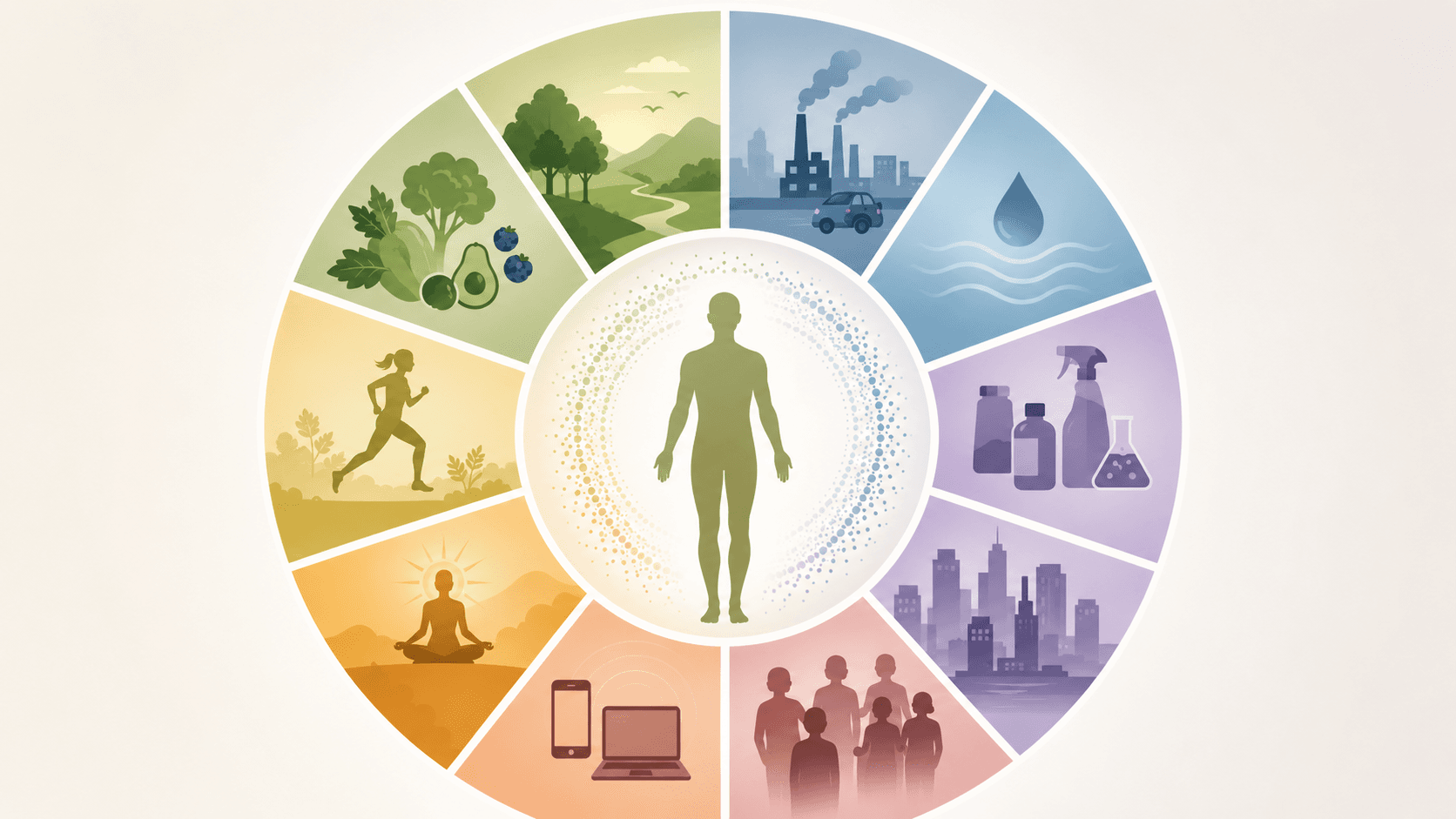
Fairly recently, research has shown us that exposure to pathogens in the environment – bacteria, viruses, parasites – not only causes infectious disease but can speed up the aging process and compromise our longevity. Scary stuff, right? Well, now another new line of research has opened up that looks at that same question – the relationship between our health and our environment – through the widest-angle lens imaginable. The “exposome” refers to the totality of everything out there that is not the body that can affect the body – infectious pathogens sure, but also industrial toxins and beyond that, your lifestyle habits like diet and exercise and, pushing out the circle of influence ever further, social and emotional traits like loneliness or feeling chronically stressed out at work. Whether we’re talking off gassing from your carpet or a bad boss at work, they all leave a recognizable biological footprint that can be measured, with the sophisticated statistics that are the epidemiologists’ stock in trade.
It’s true that a single toxin can be responsible for a single health condition – smoking and lung cancer, for instance. But much of the time, it’s the collection of toxins that we’re exposed to that puts us at risk for chronic disease, and to a greater degree than any genetic risks we may have been born with. That’s a message that I and my integrative health peers have been preaching for a long time: you are in control of the most important things that determine the quality, and the length, of your life, we’re talking the classics like diet, movement, managing stress, creating a more non-toxic home or kitchen or bathroom cabinet. Now, thanks to these cutting-edge researchers, we’re getting the hard numbers to back that up. Here’s a topline on the exposome and what’s in there that you need to know about.
Who came up with the exposome anyway?
The term was “born” in 2005 when British cancer epidemiologist Christopher Wild made what now seems like a common-sense observation. We’ve spent billions unravelling the human genome in the hopes of finding new gene-targeted medical therapies but practically nothing to unravel the health dangers in the environmental soup that our genes (as well as the rest of us) are steeping in. That needs to change given that we are, in essence, living in an uncontrolled public health experiment, exposed to things like constant screen time, social isolation, ultra-processed foods and rogue’s gallery of industrial chemicals that evolution hasn’t had time to prepare our genes to handle. Getting an accurate read-out on the damage is an important first step.
How to measure “everything.”
Quantifying environmental toxicity as a single (if huge) entity, the exposome, takes some doing, and two recent studies are leading the way. In a 2025 study published in Nature Medicine, a University of Oxford-led team analyzed health date from nearly half a million people in the UK BioBank. They sifted through hundreds of environmental and lifestyle factors to see which ones correlated with aging and death, and then compared that against genetic risk scores for 22 major diseases. The results spoke volumes. “Polygenic risk,” that is, risk associated with the specific variations in an individual’s genome, explained less than two percentage points of the variation in those who lived and those who died. Contrast that with “polyexposure risk,” the exposome in a word, which accounted for about ten times as much of variation. One bundle of different kinds of exposures, including smoking, physical activity (or its lack), and financial security, was the major force shaping mortality and the pace of biological aging.
This year, a Harvard group, published a kind of companion piece in the same prestigious academic journal, measuring a somewhat narrower slice of the exposome. Using the reams of health information collected yearly by the U.S. government NHANES survey, they looked for associations between specific environmental exposures and health outcomes. They found that exposure to a single toxin had only a modest effect on the disease risk, accounting for about 1% of the variation between people across hundreds of health conditions. That makes sense; the chronic diseases like heart disease or diabetes that shorten most of our lives are rarely caused by one single thing. But when they measured the effect of up to twenty exposures at once, then they able to explain 3.5% of the variation in people’s health outcomes. One mix of twenty exposures – including trans fats, common pollutants called polychlorinated biphenyls and vitamin E levels – accounted for almost half the variation in people’s triglyceride levels, blood lipids which, when they’re elevated, are a major risk factor for heart disease, the nation’s and the world’s leading killer.
What to do with all that data?
Collecting it is only half the battle, knowing what to do with it is the other half. That’s a work in progress. But the advantage of taking the wide-angle view of toxicity is that we can identify individual sources of contamination that spew a variety of chemical compounds contributing to multiple diseases. (Mass spectrometry in the lab now allows us to identify the presence of pollutants down to the level of a handful of molecules in a single blood draw.) If we can identify and eliminate the bad actors, or at least limit the harm they produce, that’s more regulatory bang for the buck. As one researcher in the field puts it, “We’re zooming out to figure out where to zoom back in.”
Right now, a fledgling NIH-supported program, the Network for Exposomics in the U.S (or NEXUS) is working to bring “exposomics” into mainstream research by folding smaller, studies into larger coordinated efforts, to measure and respond to toxicity around the world, at the industrial scale down to homes and neighborhoods. Researchers envision a day not so far in the future when macro data collection merges with wearable health tech. Imagine having your watch warn you that you’re breathing dangerous air, say from drifting wildfire smoke, and then gives you a read-out on the particular health vulnerabilities you need to safeguard. At the press of a button, your doctor has access to that information at your next physical.
The hot spots.
While the science is fascinating, it's neither practical nor healthy to worry about every possible environmental exposure. Chronic anxiety is its own form of stress, with well-documented effects on health. So instead, I advise my patients to focus on the exposures that pose the greatest potential risk, and the ones they have the greatest ability to change. Here are a few tips to help you do the same:
Air: Just because you can’t see it (ideally), don’t ignore it – you breathe more than 20,000 times a day! Open the window when the air is clean, run a HEPA filter when you sleep, and indoors, don’t burn candles or use synthetic air fresheners.
Water: This one’s easy. Filter it. A good carbon or reverse-osmosis filters takes out a surprisingly large share of the contaminants that most of us don’t know we’re consuming.
Food: This represents your largest daily bath of chemicals, most of which you can’t even pronounce. You should know the drill by now: eat mostly whole, unprocessed food, eliminate sugar as much as possible, choose organic or farmers’ market for the produce that in the supermarket is the most heavily dosed with pesticides; store and cook in glass or stainless steel, not plastic.
Light rhythm: We evolved to be in tune with our circadian rhythms, in other words, exposure to bright, natural light in the morning, and dim light at night. Staying in tune improves sleep, metabolism and mood.
Movement: The data is clear. Physical inactivity is strongly associated with mortality. You don’t need to become an athlete but stay physically active as if your life depended on it. It may.
Chemical clutter: Audit your personal care and cleaning products. Remember your skin is designed to let things in. And the less synthetic compounds it has to absorb, the better for you.
Relationships and stress. Admittedly, this is broad, omnibus category. But know that strong social connection and a good handle on stress are positive “exposures” that have measurable effects on the aging process, especially “inflammaging.
An uncontrolled public health experiment.
More and more refined exposome studies should give us more of a fighting chance to know what stressors and environmental insults its most important for your particular situation. They should also help us figure out our individual vulnerabilities and see how our bodies respond to stressors and insults that evolution hasn’t had time to come up with adequate defenses against, like constant screen time, social isolation, a virtual social life, a rogue’s gallery of industrial chemical, the assembly line of ultra-processed foods. Knowledge, in this case, isn't just power, it's prevention.